Water is roughly 98% of what ends up in the cup, and the last thing most people adjust. It decides which compounds come out of the grounds and which get neutralized on the way. Two numbers describe most of that, and the common error is treating them as one number.
The two are total hardness and alkalinity. The Specialty Coffee Association’s standard for home coffee brewers, SCA 310-2021, requires test water complying with the current SCA Water standard, which it summarizes as “odor-free, free of chlorine, calcium hardness equivalent to 50 to 175 ppm CaCO3, alkalinity equivalent to 40 to 70 ppm CaCO3, and pH of 6 to 8.” The same document sets a target brew strength of 1.15% to 1.55% dissolved solids, which is where the 98% comes from: at the strength the SCA is aiming for, the drink is about 98.5% water.
Hardness and alkalinity measure different things
Total hardness is the sum of the calcium and magnesium in the water. Alkalinity is the water’s capacity to absorb acid without its pH moving, defined formally as the amount of acid you would have to add to drop the sample to pH 4.3, and carried mostly by bicarbonate. High hardness with low alkalinity is a perfectly ordinary water, and so is the reverse.
That framing is not ours. It comes from the SCAE Water Chart, developed by Marco Wellinger and Samo Smrke at the Zurich University of Applied Sciences under Chahan Yeretzian, then head of the Speciality Coffee Association of Europe’s research committee. Writing in Café Europa in Winter 2016, they explained that the chart deliberately plots only these two, as “two of the most crucial drivers for coffee extraction.” They recommend total hardness of 50 to 175 ppm CaCO3 and alkalinity at or near 40 ppm CaCO3, and label the zones outside that core with the faults each direction produces: heavy, dull, chalky, flat, weak, sour, sharp.
One more term explains scale. Carbonate hardness, the fraction that can precipitate as limescale, equals whichever of the two values is lower. Water high in both is what furs up a boiler.
Why alkalinity flattens acidity
Roasted coffee is full of acids, and a bright coffee is one whose acids you can taste. Bicarbonate neutralizes them in the brew. The SCAE authors put it plainly: alkalinity “has a direct influence on the attenuation/buffering of acids extracted from coffee, so high alkalinity results in decreased acidity of the beverage.”
That is the most useful sentence on this page. If an expensive Kenyan coffee tastes muted in your kitchen and vivid in a cafe across town, the acids did not fail to extract. They were buffered away afterward, by carbonate your water utility had no reason to remove. No grind adjustment recovers them, because the problem sits downstream of the grounds. It also means the fix is asymmetric: adding minerals to soft water is easy, while getting bicarbonate out of hard water takes a decarbonizing filter, dilution, or bottled water.
Magnesium and calcium are not interchangeable, and the evidence is mixed
Hardness lumps calcium and magnesium together, which is convenient and chemically sloppy. The two ions carry the same charge, differ in size, and bind coffee’s organic molecules differently.
The theoretical case comes from Christopher Hendon, Lesley Colonna-Dashwood and Maxwell Colonna-Dashwood in the Journal of Agricultural and Food Chemistry, May 28, 2014. Using density functional theory, they calculated binding energies for sodium, magnesium and calcium against five coffee acids, caffeine and a flavor compound, and concluded that the rate and composition of extraction depend on which of those water “impurities” is present.
The SCAE team ran the experiment. Holding total hardness at 70 ppm CaCO3 and alkalinity at 40 ppm, they brewed one washed Salvadoran coffee at magnesium-to-calcium ratios of 3:1, 1:1 and 1:3. Strength did not move: dissolved and total solids sat at 1.58% across every ratio. The blind sensory panel did. At 1:3, the calcium-heavy water, they scored a significant increase in astringency and bitterness and a slight drop in fruitiness, with acidity, sweetness and body unchanged. That study was funded by BWT water+more, a company selling water treatment. The acknowledgements say so, and you should weigh it.
Then the picture got muddier. Tove Bratthäll, João Figueira and Malin Nording measured it directly in Heliyon on February 17, 2024, brewing with magnesium and calcium chloride solutions and quantifying the organic acids by GC-MS and NMR. At 100 ppm, ordinary drinking-water territory, they found limited variation between the two ions. Differences appeared only at 1000 ppm, far above anything anyone drinks. Their conclusion was that acid extraction “seems to proceed independent of divalent ions,” which is not what the computational work predicted.
Call it a modest effect on how the cup reads, none demonstrated on how much you extract, and thin evidence in both directions. Anyone quoting an ideal magnesium-to-calcium ratio to two decimal places is ahead of the research.
What distilled and fully softened water do
Distilled and reverse-osmosis water carry almost no hardness, which puts them below the SCA’s floor of 50 ppm before you start. Extraction suffers for the reason Hendon’s group described: there are no cations in the water to coordinate to the coffee. The cup comes out thin and hollow, and no grind or ratio change rescues it.
Softened water is a different trap. A domestic ion-exchange softener swaps calcium and magnesium for sodium. The hardness reading collapses; the alkalinity does not, which is exactly why the SCAE authors list softeners and decarbonizers as separate treatments. You keep the buffering that flattens acidity and lose the hardness that helps extraction, which is the worst pairing available.
The equipment argument runs the same direction. The U.S. Geological Survey noted on March 1, 2019 that lower alkalinity is one of the factors making water corrosive, along with chloride, a pH outside the neutral range, and dissolved and suspended solids, and that corrosive water can pull lead and copper out of the plumbing it sits in. That is about household pipes rather than boilers, but the chemistry does not change when the metal is hot and inside a machine, and it is no accident that the SCAE core zone is captioned as a recommendation for espresso machines and hot water boilers rather than for cups. Run a boiler on distilled water and you ask aggressive water to sit against metal at temperature; run it on water high in both hardness and alkalinity and you get scale instead.
What to do if you are not going to mix your own water
Most people should stop well short of a chemistry set. Three steps cover almost all of the available gain.
- Find out what you have. Suppliers publish hardness and alkalinity, usually in an annual quality report, and the SCAE authors note that this data is free from most providers. Two numbers, ten minutes, and you know if your water is the problem.
- Get the chlorine out. A carbon filter jug does this reliably, and chlorine-free is a hard requirement in both the SCA standard and the SCAE guidance. What the same cartridge does to hardness and alkalinity depends on how much ion-exchange resin it holds and how far through its life it is, and neither figure is on the box. Treat the jug as a chlorine fix that may or may not move your two numbers.
- Buy water only if your tap is at an extreme. Very soft supplies exist: the SCAE piece names San Francisco, with hardness and alkalinity both under 40 ppm CaCO3. Very hard ones are common. At either end, bottled water with a published mineral analysis gets you inside the range for less effort than any filter.
Past that you are into salts, syringes and a scale reading to two decimal places, and the gain is real but small. Note also what water is not: it is not where a cup’s environmental cost sits. That is on the farm and in the milk, which is why we keep naming the specific impact rather than the adjective, and it moves no more with your kettle than with the choice between a paper and a metal filter. Water is the cheapest variable in brewing and the one most likely to be quietly spoiling coffee you have already paid for. Read your utility’s report before you buy another grinder.
Sources
- Specialty Coffee Association — SCA Standard 310-2021, Home Coffee Brewers: Specifications and Test Methods
- Café Europa, Speciality Coffee Association of Europe — Charting Water for Better Coffee
- ZHAW digitalcollection — The SCAE water chart: measure aim treat
- Journal of Agricultural and Food Chemistry — The Role of Dissolved Cations in Coffee Extraction
- Heliyon — Influence of divalent cations on the extraction of organic acids in coffee determined by GC-MS and NMR
- U.S. Geological Survey — Corrosivity
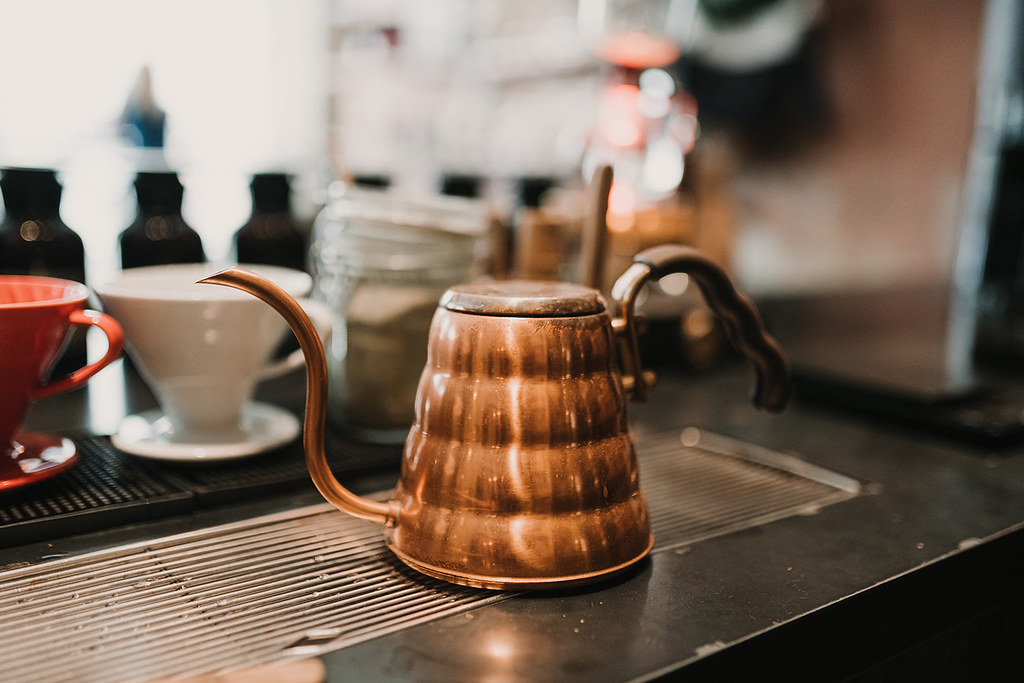
Image: “Gooseneck Kettle” by markolaz, licensed under CC BY 2.0. Via the original.